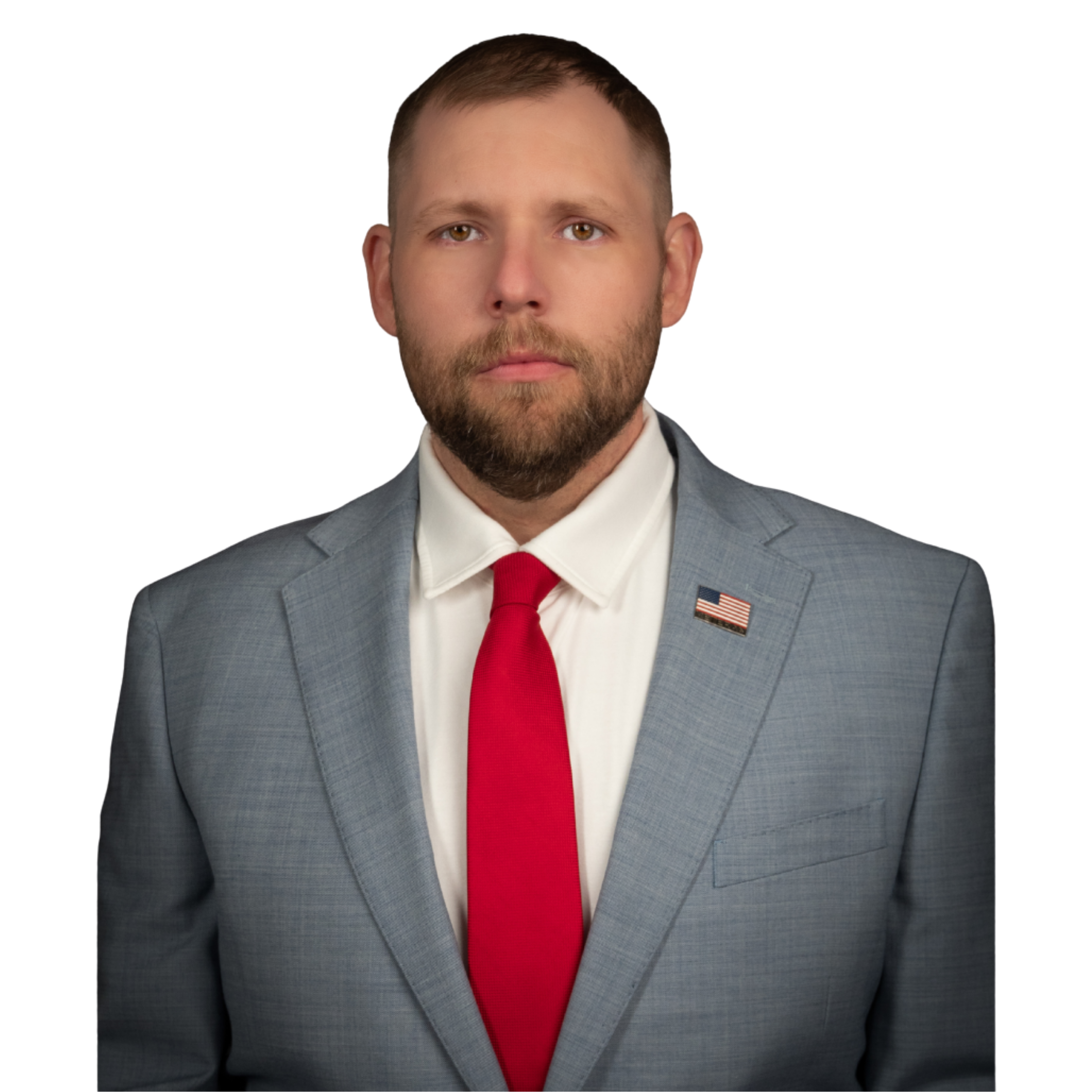
Austin Tomlinson
Army veteran, first-generation college student, and the only lawyer at Patriot Law. Every case here is handled by the person whose name is on the door.
One Lawyer, Start to Finish
Austin Tomlinson is a Nashville criminal defense attorney and a United States Army veteran, licensed in Tennessee under BPR #039453. He has worked both sides of a criminal case — as an intern in a prosecutor's office during law school, then at one of the largest criminal defense firms in the country — and he now runs Patriot Law as a one-lawyer practice in Middle Tennessee.
In his own words: “I am proud to be an Army veteran and a first-generation college student.” The route was not the usual one. He studied history and political science at South Dakota State University, enlisted, and went to law school at West Virginia University afterwards, where he served as president of his class.
The practical consequence for a client is simple. There is no intake team handing you to an associate, and no associate handing you back. The person who takes your first call is the person who knows the file at the end of it.
Background and Credentials
Everything below is a matter of record. Bar status can be confirmed independently through the Tennessee Board of Professional Responsibility using the BPR number.
| Detail | |
|---|---|
| Bar admission | Tennessee. BPR #039453, the number carried on every page of this site |
| Law school | West Virginia University, Juris Doctor |
| Law school leadership | Served as president of his class |
| Undergraduate | South Dakota State University, history and political science, before he enlisted |
| Military service | United States Army. He describes it as where the path to practicing law began |
| Prosecution side | Interned with the prosecutor's office during law school |
| Defense side | Worked at one of the largest criminal defense firms in the country |
| Practice today | Criminal defense, and only criminal defense, across seven Middle Tennessee counties |
The prosecution internship is worth noting for one reason: charging and plea decisions are made by people, inside an office, according to habits. Having been inside one is a different vantage point from reading the file afterwards.
Named a 10 Best Law Firm for Client Satisfaction

Awarded by the American Institute of Criminal Law Attorneys. The organization's published basis for the selection is client satisfaction — how people felt about being represented — rather than case outcomes, verdict records or any assessment of legal ability.
That distinction is worth stating plainly, because a gold badge on a law firm's website can imply more than it means. An award is not a prediction. No organization's recognition, this one included, tells you how a particular case will end.
The Army Came First
Austin puts it plainly on his own account of it: “My journey to becoming an attorney began with my service in the United States Army, where I developed a strong sense of duty, discipline, and resilience.” The firm is named for that, and it is the reason a large part of the practice is built around people who served.
-
A charge costs a service member things it does not cost a civilian
The same conviction that means a fine and probation for one person can mean a security clearance for another, or a discharge characterization, or a benefit that stops arriving. Those consequences run on separate tracks from the criminal case and they do not wait for it to finish. The pages on security clearance and VA benefits and the UCMJ alongside civilian charges go through the specific provisions.
-
Tennessee has no veterans-specific diversion statute
This is the part most firms get wrong in their marketing. Diversion works the same for veterans as for everyone else. Judicial diversion under § 40-35-313 turns on the offense and the record, not on service history — and its bars are real. Sexual offenses are out. Class A and B felonies are out. DUI is expressly out under § 40-35-313(a)(1)(B)(i)(c). So is anyone previously granted judicial or pretrial diversion, which makes it a once-in-a-lifetime option rather than a renewable one.
-
What does vary by county is whether there is a veterans court at all
Of the seven counties this firm covers, three have one: Davidson, Williamson, and Rutherford through the 16th Judicial District's court, which it shares with Cannon County. Sumner, Wilson, Cheatham and Smith have none. That is not necessarily the end of it — § 16-6-107 provides for a motion to transfer a criminal case to a veterans treatment court program in a contiguous county. Whether that is worth pursuing is a case-by-case question, and it is one worth raising early rather than after a plea is on the table.
-
Knowing the vocabulary saves a conversation you should not have to have
Being a veteran does not change the law that applies to your case. It changes whether the person defending you needs the difference between a general discharge and an other than honorable one explained to them while the clock is running.
What To Expect
The first call costs nothing
It is usually enough to tell you what the realistic range of outcomes is and what has to happen first. If this is not the right firm for your case, you will hear that on the call rather than after a consultation.
No promises about outcomes
Nobody can tell you how a criminal case will end, and a lawyer who does on a first call is telling you something about themselves rather than about your case. What you will get is a straight read on where you stand.
Local procedure is half the work
Docket days, rotations, grand jury cycles and diversion practice differ county by county in Middle Tennessee. That is why this site has a page for each one rather than a single page with the county name swapped.
What Austin Defends
Veterans
Where
Seven counties across Middle Tennessee, with the bulk of the work in Nashville and Davidson County.
Areas served · Nashville & Davidson County · All practice areas
Questions About Working With Austin
Will Austin handle my case himself?
Yes. Patriot Law is a one-lawyer firm by design. The person who answers your first call, appears at your first setting and stands next to you at the end is the same person. That is not true at every firm, and on a criminal case it matters, because the leverage in a case is usually built early and by whoever was in the room.
He is a veteran. Does that change anything about my case?
Not the law, and any lawyer who tells you otherwise is overselling. Tennessee has no veterans-specific diversion statute — diversion works the same for veterans and non-veterans. What it changes is whether your lawyer already understands the things a criminal charge can cost a service member or veteran that it would not cost a civilian: a security clearance, VA benefits, a career. The veterans defense section goes through those in detail.
Does Patriot Law only take veterans' cases?
No. Austin is a veteran and the firm was built around defending people who served, but the practice is criminal defense for anyone charged in Middle Tennessee, veteran or not. The service background is a credential, not a filter.
Where does he practice?
Davidson, Williamson, Rutherford, Sumner, Wilson, Cheatham and Smith counties, with the bulk of the work in Nashville and Davidson County. The areas served page lists every county and city, and each of those pages covers how that particular court system actually works.